
- A Fair Comparision
Legacy DLP vs. AI interaction security
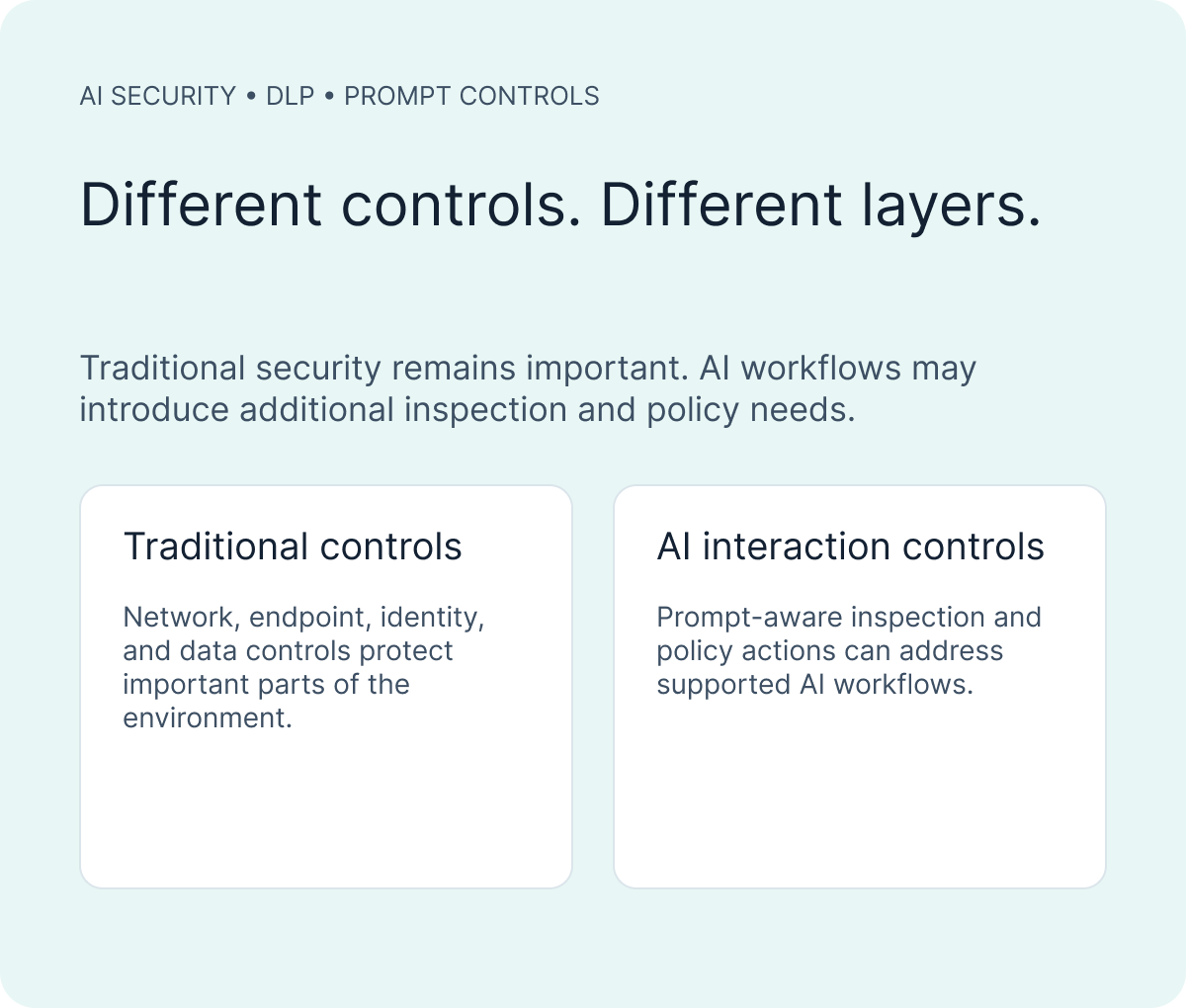
Keep your existing controls. Evaluate the gaps.
What traditional DLP does well
Classifies data, applies policies, and monitors or blocks transfers across supported endpoints, networks, email, and cloud services.
Where AI creates new questions
Prompts, responses, file uploads, browser interactions, and AI agents may require context-aware inspection in specific workflows.
What to verify
Test the products and integrations: which AI services, data types, channels, actions, and logs are covered?
A practical capability comparison
Capability | Traditional DLP and security controls | AI interaction security |
Network and data-transfer controls | Established capabilities across supported network and transfer paths | Can complement network controls, depending on deployment |
Endpoint and file inspection | Available in many products for supported workflows | Can add AI-specific checks where supported |
Prompt and response context | Varies by product and integration | Focuses on supported AI interaction workflows |
Browser-based AI activity | Depends on browser, endpoint, and application coverage | May provide controls tailored to supported browser-based AI usage |
Sensitive-data redaction | Depends on the product and configured actions | Can provide redaction designed for supported AI content |
Policy enforcement | Applies policies across supported channels and applications | Can apply controls to supported AI interactions |
Audit and investigation | Depends on available logging and reporting | Can provide AI interaction visibility and audit capabilities, subject to configuration |
“Not built for prompts” is a question to test - not a universal fact.
Where does inspection happen?
At the endpoint, browser, network, API gateway, or inside an integrated application? What content is visible?
What actions are possible?
Can the control alert, block, redact, quarantine, or route users to an approved tool in the target workflow?
What evidence is retained?
Which events, file interactions, policy decisions, and investigation records can authorized teams review?
Complement your security stack with AI-focused controls.
Masker
Masker protects AI usage across browsers, AI gateways, desktop applications, and AI agents through a unified security and governance platform. It brings security controls together to help organizations manage AI interactions and apply policies across supported environments.
Redactor
Redactor helps protect personally identifiable information (PII) and protected health information (PHI) by redacting sensitive data in real time. It replaces sensitive information with safe, format-preserving data across supported images, documents, and PDFs before the information leaves your network.
Protector
Protector helps organizations control AI usage within employee browsers and guide users toward secure AI adoption. It supports visibility and security controls for browser-based AI workflows, helping teams manage unauthorized AI tools and reduce the risk of sensitive information being submitted through prompts.
Governor
Governor is the unified governance layer built into every layer of Masker. It supports policy enforcement, auditability, and compliance-related oversight by providing visibility into AI interactions and helping organizations identify and investigate potential policy breaches.
- Use Cases
Real-World Applications

Patient Data Exposure Through AI Tools: The Johns Hopkins Case
A recent data breach at Czech online supermarket Rohlík highlights a growing challenge for businesses: protecting the sensitive information stored

Rohlík Data Breach: The Hidden Risk of Exposed AI Conversations
A recent data breach at Czech online supermarket Rohlík highlights a growing challenge for businesses: protecting the sensitive information stored
Test the controls against your real AI workflows.
DLP and AI security: common questions
Does traditional DLP work with ChatGPT?
Are firewalls obsolete for AI security?
Does SecurePledge replace DLP?
No. It is intended to complement the broader security stack with AI interaction controls in supported workflows.